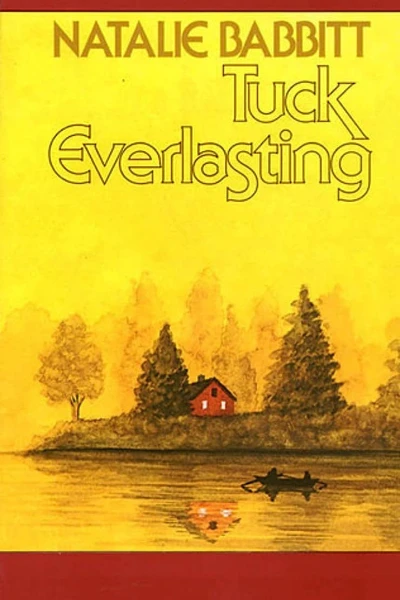
Tuck Everlasting
Tuck Everlasting — Epilogue
Epilogue
The sign said WELCOME TO TREEGAP, but it was hard to believe that this was really Treegap. The main street hadn’t changed so very much, but there were many other streets now, crossing the main street. The road itself was blacktopped. There was a white line painted down its center.
Mae and Tuck, on the seat of a clattering wooden wagon, bumped slowly into Treegap behind the fat old horse. They had seen continuous change and were accustomed to it, but here it seemed shocking and sad.
“Look,” said Tuck. “Look, Mae. Ain’t that where the wood used to be? It’s gone! Not a stick or a stump left! And her cottage—that’s gone, too.”
It was very hard to recognize anything, but from the little hill, which had once lain outside the village and was now very much a part of it, they thought they could figure things out. “Yes,” said Mae, “that’s where it was, I do believe. ’Course, it’s been so long since we was here, I can’t tell for certain.”
There was a gas station there now. A young man in greasy coveralls was polishing the windshield of a wide and rusty Hudson automobile. As Mae and Tuck rolled past, the young man grinned and said to the driver of the Hudson, who lounged at the wheel, “Looky there. In from the country for a big time.” And they chuckled together.
Mae and Tuck clattered on into the village proper, past a catholic mixture of houses which soon gave way to shops and other places of business: a hot-dog stand; a dry cleaner; a pharmacy; a five-and-ten; another gas station; a tall, white frame building with a pleasant verandah, The Treegap Hotel—Family Dining, Easy Rates. The post office. Beyond that, the jailhouse, but a larger jailhouse now, painted brown, with an office for the county clerk. A black and white police car was parked in front, with a red glass searchlight on its roof and a radio antenna, like a buggy whip, fastened to the windshield.
Mae glanced at the jailhouse, but looked away quickly. “See beyond there?” she said, pointing. “That diner? Let’s stop there and get a cup of coffee. All right?”
“All right,” said Tuck. “Maybe they’ll know something.”
Inside, the diner gleamed with chrome and smelled like linoleum and ketchup. Mae and Tuck took seats on rumbling swivel stools at the long counter. The counterman emerged from the kitchen at the rear and sized them up expertly. They looked all right. A little queer, maybe—their clothes, especially—but honest. He slapped a cardboard menu down in front of them and leaned on the foaming orangeade cooler. “You folks from off?” he asked.
“Yep,” said Tuck. “Just passing through.”
“Sure,” said the counterman.
“Say,” said Tuck cautiously, fingering the menu. “Didn’t there used to be a wood once, down the other side of town?”
“Sure,” said the counterman. “Had a big electrical storm, though, about three years ago now or thereabouts. Big tree got hit by lightning, split right down the middle. Caught fire and everything. Tore up the ground, too. Had to bulldoze her all out.”
“Oh,” said Tuck. He and Mae exchanged glances.
“Coffee, please,” said Mae. “Black. For both of us.”
“Sure,” said the counterman. He took the menu away, poured coffee into thick pottery mugs, and leaned again on the orangeade cooler.
“Used to be a fresh-water spring in that wood,” said Tuck boldly, sipping his coffee.
“Don’t know nothing about that,” said the counterman. “Had to
bulldoze her all out, like I say.”
“Oh,” said Tuck.
Afterward, while Mae was shopping for supplies, Tuck went back through the town on foot—back the way they had come—out to the little hill. There were houses there now, and a feed-and-grain store, but on the far side of the hill, inside a rambling iron fence, was a cemetery.
Tuck’s heart quickened. He had noticed the cemetery on the way in.
Mae had seen it, too. They had not spoken about it. But both knew it might hold other answers. Tuck straightened his old jacket. He passed through an archway of wrought-iron curlicues, and paused, squinting at the weedy rows of gravestones. And then, far over to the right, he saw a tall
monument, once no doubt imposing but now tipped slightly sidewise. On it was carved one name: Foster.
Slowly, Tuck turned his footsteps toward the monument. And saw, as he approached, that there were other, smaller markers all around it. A family plot. And then his throat closed. For it was there. He had wanted it to be there, but now that he saw it, he was overcome with sadness. He knelt and
read the inscription:
In Loving Memory
Winifred Foster Jackson
Dear Wife
Dear Mother 1870–1948
“So,” said Tuck to himself. “Two years. She’s been gone two years.” He stood up and looked around, embarrassed, trying to clear the lump from his throat. But there was no one to see him. The cemetery was very quiet. In the branches of a willow behind him, a red-winged blackbird chirped. Tuck wiped his eyes hastily. Then he straightened his jacket again and drew up his hand in a brief salute. “Good girl,” he said aloud. And then he turned and left the cemetery, walking quickly.
Later, as he and Mae rolled out of Treegap, Mae said softly, without
looking at him, “She’s gone?”
Tuck nodded. “She’s gone,” he answered.
There was a long moment of silence between them, and then Mae said, “Poor Jesse.”
“He knowed it, though,” said Tuck. “At least, he knowed she wasn’t coming. We all knowed that, long time ago.”
“Just the same,” said Mae. She sighed. And then she sat up a little straighter. “Well, where to now, Tuck? No need to come back here no more.”
“That’s so,” said Tuck. “Let’s just head on out this way. We’ll locate something.”
“All right,” said Mae. And then she put a hand on his arm and pointed.
“Look out for that toad.”
Tuck had seen it, too. He reined in the horse and climbed down from the wagon. The toad was squatting in the middle of the road, quite
unconcerned. In the other lane, a pickup truck rattled by, and against the breeze it made, the toad shut its eyes tightly. But it did not move. Tuck waited till the truck had passed, and then he picked up the toad and carried it to the weeds along the road’s edge. “Durn fool thing must think it’s going to live forever,” he said to Mae.
And soon they were rolling on again, leaving Treegap behind, and as they went, the tinkling little melody of a music box drifted out behind them and was lost at last far down the road.
End of book
You finished Tuck Everlasting
by Natalie Babbitt