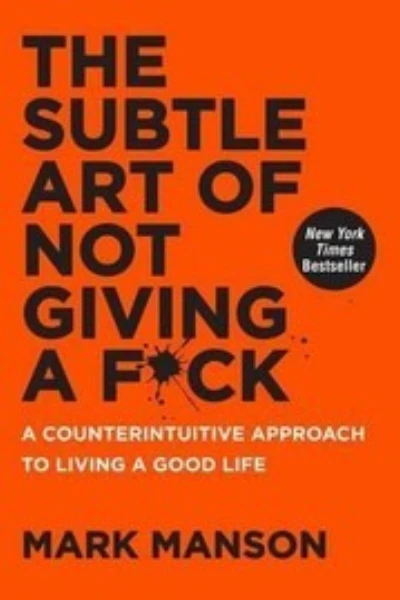
The Subtle Art of Not Giving a F*ck
The Subtle Art of Not Giving a F*ck — CHAPTER 6: You’re Wrong About Everything (But So Am I)
CHAPTER 6
You’re Wrong About Everything (But So Am I)
Five hundred years ago cartographers believed that California was an island. Doctors believed that slicing a person’s arm open (or causing bleeding anywhere) could cure disease. Scientists believed that fire was made out of something called phlogiston. Women believed that rubbing dog urine on their face had anti-aging benefits. Astronomers believed that the sun revolved around the earth.
When I was a little boy, I used to think “mediocre” was a kind of vegetable that I didn’t want to eat. I thought my brother had found a secret passageway in my grandmother’s house because he could get outside without having to leave the bathroom (spoiler alert: there was a window). I also thought that when my friend and his family visited “Washington, B.C.,” they had somehow traveled back in time to when the dinosaurs lived, because after all, “B.C.” was a long time ago.
As a teenager, I told everybody that I didn’t care about anything, when the truth was I cared about way too much. Other people ruled my world without my even knowing. I thought happiness was a destiny and not a choice. I thought love was something that just happened, not something that you worked for. I thought being “cool” had to be practiced and learned from others, rather than invented for oneself.
When I was with my first girlfriend, I thought we would be together forever. And then, when that relationship ended, I thought I’d never feel the same way about a woman again. And then when I felt the same way about a woman again, I thought that love sometimes just wasn’t enough. And then I realized that each individual gets to decide what is “enough,” and that love can be whatever we let it be.
Every step of the way I was wrong. About everything. Throughout my life, I’ve been flat-out wrong about myself, others, society, culture, the world, the universe—everything.
And I hope that will continue to be the case for the rest of my life.
Just as Present Mark can look back on Past Mark’s every flaw and mistake, one day Future Mark will look back on Present Mark’s assumptions (including the contents of this book) and notice similar flaws. And that will be a good thing. Because that will mean I have grown.
There’s a famous Michael Jordan quote about him failing over and over and over again, and that’s why he succeeded. Well, I’m always wrong about everything, over and over and over again, and that’s why my life improves.
Growth is an endlessly iterative process. When we learn something new, we don’t go from “wrong” to “right.” Rather, we go from wrong to slightly less wrong. And when we learn something additional, we go from slightly less wrong to slightly less wrong than that, and then to even less wrong than that, and so on. We are always in the process of approaching truth and perfection without actually ever reaching truth or perfection.
We shouldn’t seek to find the ultimate “right” answer for ourselves, but rather, we should seek to chip away at the ways that we’re wrong today so that we can be a little less wrong tomorrow.
When viewed from this perspective, personal growth can actually be quite scientific. Our values are our hypotheses: this behavior is good and important; that other behavior is not. Our actions are the experiments; the resulting emotions and thought patterns are our data.
There is no correct dogma or perfect ideology. There is only what your experience has shown you to be right for you—and even then, that experience is probably somewhat wrong too. And because you and I and everybody else all have differing needs and personal histories and life circumstances, we will all inevitably come to differing “correct” answers about what our lives mean and how they should be lived. My correct answer involves traveling alone for years on end, living in obscure places, and laughing at my own farts. Or at least that was the correct answer up until recently. That answer will change and evolve, because I change and evolve; and as I grow older and more experienced, I chip away at how wrong I am, becoming less and less wrong every day.
Many people become so obsessed with being “right” about their life that they never end up actually living it.
A certain woman is single and lonely and wants a partner, but she never gets out of the house and does anything about it. A certain man works his ass off and believes he deserves a promotion, but he never explicitly says that to his boss.
They’re told that they’re afraid of failure, of rejection, of someone saying no.
But that’s not it. Sure, rejection hurts. Failure sucks. But there are particular certainties that we hold on to—certainties that we’re afraid to question or let go of, values that have given our lives meaning over the years.
That woman doesn’t get out there and date because she would be forced to confront her beliefs about her own desirability. That man doesn’t ask for the promotion because he would have to confront his beliefs about what his skills are actually worth.
It’s easier to sit in a painful certainty that nobody would find you attractive, that nobody appreciates your talents, than to actually test those beliefs and find out for sure.
Beliefs of this sort—that I’m not attractive enough, so why bother; or that my boss is an asshole, so why bother—are designed to give us moderate comfort now by mortgaging greater happiness and success later on. They’re terrible long-term strategies, yet we cling to them because we assume we’re right, because we assume we already know what’s supposed to happen. In other words, we assume we know how the story ends.
Certainty is the enemy of growth. Nothing is for certain until it has already happened—and even then, it’s still debatable. That’s why accepting the inevitable imperfections of our values is necessary for any growth to take place.
Instead of striving for certainty, we should be in constant search of doubt: doubt about our own beliefs, doubt about our own feelings, doubt about what the future may hold for us unless we get out there and create it for ourselves.
Instead of looking to be right all the time, we should be looking for how we’re wrong all the time. Because we are.
Being wrong opens us up to the possibility of change. Being wrong brings the opportunity for growth. It means not cutting your arm open to cure a cold