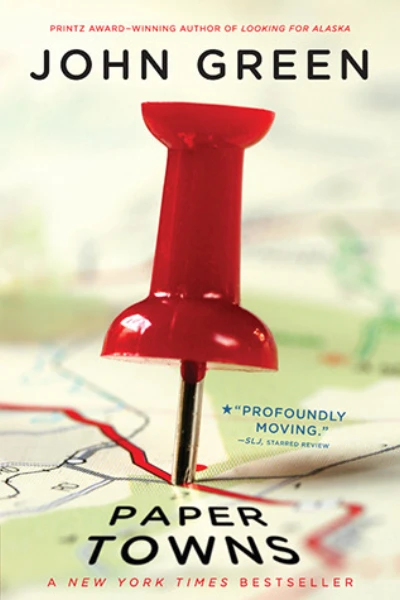
Paper Towns
Paper Towns — Chapter no 28
28.
After three long hours alone with eight hundred words from Ovid on
Monday morning, I walked through the halls feeling as if my brain might
drip out of my ears. But I’d done okay. We had an hour and a half for lunch,
to give our minds time to firm back up before the second exam period of the
day. Radar was waiting for me at my locker.
“I just bombed me some Spanish,” Radar said.
“I’m sure you did okay.” He was going to Dartmouth on a huge
scholarship. He was plenty smart.
“Dude, I don’t know. I kept falling asleep during the oral part. But
listen, I was up half the night building this program. It’s so awesome. What
it does is it allows you to enter a category—it can be a geographical area or
like a family in the animal kingdom— and then you can read the first
sentences of up to a hundred Omnictionary articles about your topic on a
single page. So, like, say you are trying to find a particular kind of rabbit
but can’t remember its name. You can read an introduction to all twenty-one
species of rabbits on the same page in, like, three minutes.”
“You did this the night before finals?” I asked.
“Yeah, I know, right? Anyway I’ll email it to you. It’s nerd-tastic.”
Ben showed up then. “I swear to God, Q, Lacey and I were up on IM
until two o’clock in the morning playing on that site, the-longwayround?
And having now plotted every single possible trip that Margo could have
taken between Orlando and those five points, I realize I was wrong all this
time. She’s not in Orlando. Radar’s right. She’s coming back here for
graduation day.”
“Why?”
“The timing is perfect. To drive from Orlando to New York to the
mountains to Chicago to Los Angeles back to Orlando is like exactly a
twenty-three-day trip. Plus, it’s a totally retarded joke, but it’s a Margo joke.
You make everyone think you offed yourself. Surround yourself with an air
of mystery so that everyone pays attention. And then right as all the
attention starts to go away, you show up at graduation.”
“No,” I said. “No way.” I knew Margo better than that by now. She did
want attention. I believed that. But Margo didn’t play life for laughs. She
didn’t get off on mere trickery.
“I’m telling you, bro. Look for her at graduation. She’s gonna be there.”
I just shook my head. Since everyone had the same lunch period, the
cafeteria was beyond packed, so we exercised our rights as seniors and
drove to Wendy’s. I tried to stay focused on my coming calc exam, but I
was starting to feel like maybe there was more string to the story. If Ben
was right about the twenty-three-day trip, that was very interesting, indeed.
Maybe that’s what she’d been planning in her black notebook, a long and
lonesome road trip. It didn’t explain everything, but it did fit with Margo as
a planner. Not that this brought me closer to her. As hard as it is to pinpoint
a dot inside a ripped segment of a map, it only becomes harder when the dot
is moving.
After a long day of finals, returning to the comfortable impenetrability of
“Song of Myself” was almost a relief. I had reached a weird part of the
poem—after all this time listening and hearing people, and then traveling
alongside them, Whitman stops hearing and he stops visiting, and he starts
to become other people. Like, actually inhabit them. He tells the story of a
ship’s captain who saved everyone on his boat except himself. The poet can
tell the story, he argues, because he has become the captain. As he writes, “I
am the man . . . . I suffered . . . . I was there.” A few lines later, it becomes
even more clear that Whitman no longer needs to listen to become another:
“I do not ask the wounded person how he feels . . . . I myself become the
wounded person.”
I put the book down and lay on my side, staring out the window that had
always been between us. It is not enough just to see her or hear her. To find
Margo Roth Spiegelman, you must become Margo Roth Spiegelman.
And I had done many of the things she might have done: I had
engineered a most unlikely prom coupling. I had quieted the hounds of
caste warfare. I had come to feel comfortable inside the rat-infested haunted
house where she did her best thinking. I had seen. I had listened. But I could
not yet become the wounded person.
I limped through my physics and government finals the next day and then
stayed up till 2 A.M. on Tuesday finishing my final reaction paper for
English about Moby Dick. Ahab was a hero, I decided. I had no particular
reason for having decided this—particularly given that I hadn’t read the
book—but I decided it and reacted thusly.
The abbreviated exam week meant that Wednesday was the last day of
school for us. And all day long, it was hard not to walk around thinking
about the lastness of it all: The last time I stand in a circle outside the band
room in the shade of this oak tree that has protected generations of band
geeks. The last time I eat pizza in the cafeteria with Ben. The last time I sit
in this school scrawling an essay with a cramped hand into a blue book. The
last time I glance up at the clock. The last time I see Chuck Parson prowling
the halls, his smile half a sneer. God. I was becoming nostalgic for Chuck
Parson. Something sick was happening inside of me.
It must have been like this for Margo, too. With all the planning she’d
done, she must have known she was leaving, and even she couldn’t have
been totally immune to the feeling. She’d had good days here. And on the
last day, the bad days become so difficult to recall, because one way or
another, she had made a life here, just as I had. The town was paper, but the
memories were not. All the things I’d done here, all the love and pity and
compassion and violence and spite, kept welling up inside me. These
whitewashed cinder-block walls. My white walls. Margo’s white walls.
We’d been captive in them for so long, stuck in their belly like Jonah.
Throughout the day, I found myself thinking that maybe this feeling was
why she’d planned everything so intricately and precisely: even if you want
to leave, it is so hard. It took preparation, and maybe sitting in that minimall
scrawling her plans was both intellectual and emotional practice—Margo’s
way of imagining herself into her fate.
Ben and Radar both had a marathon band practice to make sure they
would rock “Pomp and Circumstance” at graduation. Lacey offered me a
ride, but I decided to clean out my locker, because I didn’t really want to
come back here and again have to feel like my lungs were drowning in this
perverse nostalgia.
My locker was an unadulterated crap hole—half trash can, half book
storage. Her locker had been neatly stacked with textbooks when Lacey
opened it, I remembered, as if she intended to come to school the next day. I
pulled a garbage can over to the bank of lockers and opened mine up. I
began by pulling off a picture of Radar and Ben and me goofing off. I put it
inside my backpack and then started the disgusting process of picking
through a year’s worth of accumulated filth—gum wrapped in scraps of
notebook paper, pens out of ink, greasy napkins—and scraping it all into the
garbage. All along, I kept thinking, I will never do this again, I will never
be here again, this will never be my locker again, Radar and I will never
write notes in calculus again, I will never see Margo across the hall again.
This was the first time in my life that so many things would never happen
again.
And finally it was too much. I could not talk myself down from the
feeling, and the feeling became unbearable. I reached in deep to the recesses
of my locker. I pushed everything—photographs and notes and books—into
the trash can. I left the locker open and walked away. As I walked past the
band room, I could hear through the walls the muffled sounds of “Pomp and
Circumstance.” I kept walking. It was hot outside, but not as hot as usual. It
was bearable. There are sidewalks most of the way home, I thought. So I
kept walking.
And as paralyzing and upsetting as all the never agains were, the final
leaving felt perfect. Pure. The most distilled possible form of liberation.
Everything that mattered except one lousy picture was in the trash, but it
felt so great. I started jogging, wanting to put even more distance between
myself and school.
It is so hard to leave—until you leave. And then it is the easiest
goddamned thing in the world.
As I ran, I felt myself for the first time becoming Margo. I knew: she is
not in Orlando. She is not in Florida. Leaving feels too good, once you
leave. If I’d been in a car, and not on foot, I might have kept going, too. She
was gone and not coming back for graduation or anything else. I felt sure of
that now.
I leave, and the leaving is so exhilarating I know I can never go back.
But then what? Do I just keep leaving places, and leaving them, and leaving
them, tramping a perpetual journey?
Ben and Radar drove past me a quarter mile from Jefferson Park, and
Ben brought RHAPAW to a screeching halt right on Lakemont in spite of
traffic everywhere, and I ran up to the car and got in. They wanted to play
Resurrection at my house, but I had to tell them no, because I was closer
than I’d ever been before.