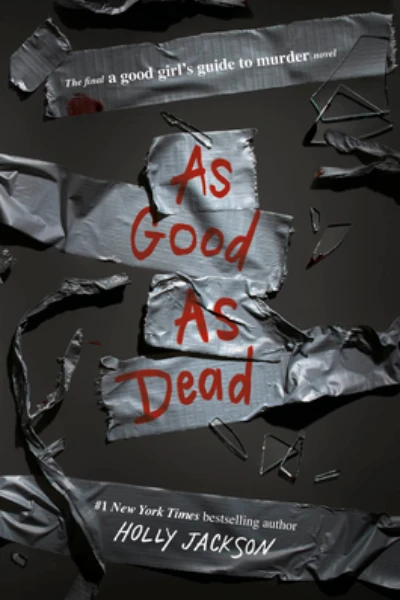
As Good as Dead
As Good as Dead — Chapter no 5
Death stared back at her. Real death, not the clean, idealized version of it. The purpling, pockmarked skin of a corpse, and the eerie, forever-whitened imprint of a too-tight belt they must have worn as they died. It was almost funny, in a way, Pip thought as she scrolled down the page on her laptop. Funny in the way that if you thought about it too long, you’d go mad. We all end up like this eventually, like these postmortem images on a badly formatted webpage about body decomposition and time of death.
Her arm was resting on her notebook, steadily filling up with her scribbles. Underlines here and highlighted parts there. And now she added another sentence below, glancing up at the screen as she wrote: If the body feels warm and stiff, death occurred three to eight hours prior.
“Are those dead bodies?!”
The voice pierced through the cushion of her noise-canceling headphones; she hadn’t heard anyone come in.
Pip flinched, her heart jumping to her throat. She dropped her headphones to her neck and sound came rushing back in, a familiar sigh behind her. These headphones blocked almost everything out, that’s why Josh kept stealing them to play FIFA, so he could “noise-cancel Mom.” Pip lurched forward to switch to another tab. But, actually,
none of them was any better.
“Pip?” Her mom’s voice hardened.
Pip spun her desk chair, overstretching her eyes to cover their guilt. Her mom was standing right behind her, one wrist cocked against her hip. Her blond hair was manic, sections folded up into foil like a metal Medusa. It was highlighting day. They happened more frequently now that her roots were starting to show gray. She still had on her clear latex gloves, smudges of hair dye on the fingers.
“Well?” she prompted.
“Yes these are dead bodies,” Pip said.
“And why, dear daughter, are you looking at dead bodies at eight a.m. on a Friday morning?”
Was it really only eight o’clock? Pip had been up since five.
“You told me to get a hobby,” she said, shrugging.
“Pip,” her mom said sternly, although the turn of her mouth had a hint of amusement in it.
“It’s for my new case,” Pip conceded, turning back to the screen. “You know that Jane Doe case I told you about? The one who was found by the Hudson nine years ago? I’m going to investigate it for the podcast while I’m
at college. Try to find out who she was and who killed her. I’ve already been lining up interviews over the next few months. This is relevant research, I swear,” she said, hands up in surrender.
“Another season of the podcast?” Pip’s mom raised a concerned eyebrow. How could one eyebrow communicate so much? She’d somehow managed to fit around three months’ worth of worry and unease into that one small line of hair.
“Well, I’ve somehow got to fund the lifestyle to which I have grown accustomed. You know, expensive future libel trials, lawyer fees…” Pip said. And illegal, unprescribed benzodiazepines, she thought secretly. But those weren’t the real reasons; not even close.
“Very funny.” Her mom’s eyebrow relaxed. “Just…be careful with yourself. Take a break if you need it, and I’m always here to talk if…” She reached out for Pip’s shoulder, forgetting about the hair-dye-covered gloves until the very last second. She stalled, lingering an inch above, and maybe Pip imagined it, but she could somehow feel the warmth from her mom’s hovering hand. It felt nice, like a small shield against her skin.
“Yeah” was all Pip could think of to say.
“And let’s keep the graphic dead bodies to a minimum, yes?” She nodded at the screen. “We have a ten-year- old in the house.”
“Oh, I’m sorry,” Pip said. “I forgot about Josh’s new ability to see through walls, my bad.”
“Honestly, he’s everywhere at the moment,” her mom said, lowering her voice to a whisper, checking behind her. “Don’t know how he does it. He overheard me saying fuck yesterday, but I could’ve sworn he was on the other side of the house. Why is it purple?”
“Huh,” Pip said, taken aback until she followed her mom’s eyes to the laptop screen. “Oh, it’s called ‘lividity.’ It’s what happens to the blood when you die, it pools on the…Do you really want to know?”
“Not really, sweetie, I was feigning interest.”
“Thought so.”
Her mom turned toward the door, hair foil crinkling. She paused at the threshold. “Josh is walking in with Sam today; Lynne will be here any minute to pick him up. How about when he’s gone, I make a nice big breakfast for the two of us?” She smiled hopefully. “Pancakes or something?”
Pip’s mouth felt dry, her tongue like an overgrown aberration sticking to the roof of her mouth. She used to love her mom’s pancakes, thick and so syrupy they might just glue your mouth together. Right now, the thought of them made her feel a little sick, but she fixed a matching smile onto her face. “That would be nice. Thanks, Mom.”
“Perfect.” Her mom’s eyes crinkled, glittering as her smile stretched into them. A smile too wide.
Pip’s gut twisted with guilt; this was all her fault. Her family forced into a performance, trying twice as hard with her because she could barely try at all.
“It’ll be about an hour, then.” Pip’s mom gestured to her hair. “And don’t expect to see your haggard mother at breakfast; instead there will be a newly blonded bombshell.”
“Can’t wait,” Pip said, trying. “I hope the bombshell’s coffee is slightly less weak than my haggard mother’s.”
Her mom rolled her eyes and wandered out of the room, muttering under her breath about Pip and her dad and their strong coffee that tastes like shi— “I heard that!” Josh’s voice sailed through the house.
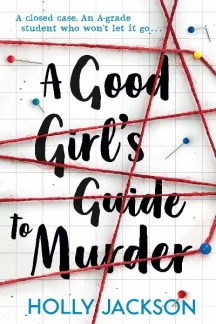
Pip sniffed, running her fingers around the padded cushions of her headphones cradling her neck. She traced her finger up the smooth plastic of the headband, to the part where the texture changed: the roughened, bumpy sticker wrapped around its width. It was an A Good Girl’s Guide to Murder sticker, with the logo from her podcast.
Ravi had had them made as a present when she released the final episode of season 2, the hardest one to record yet.
The story of what happened inside that old abandoned farmhouse, now burned to the ground, a trail of blood through the grass that they’d had to hose away.
So sad, commenters would say.
Don’t know why she sounds upset, said others. She asked for this.
Pip had told the story, but she never really told the heart of it: that it had broken her.
She pulled the headphones back over her ears and blocked out the world. No sound, only the fizzing inside her own head. She closed her eyes too, and pretended there was no past, no future. It was just this: absence. It was a comfort, floating there free and untethered, but her mind was never quiet for long.
And neither were the headphones. A high-pitched ping sounded in her ears. Pip flipped her phone over to check the notification. An email had come through the form on her website. That same message again: Who will look for you when you’re the one who disappears? From anonymous987654321@gmail.com. A different email address again, but the same exact message. Pip had been getting them on and off for months now, along with the other colorful comments from trolls. At least it was more poetic and reflective than the straight-cut rape threats.
Who will look for you when you’re the one who disappears?
Pip stalled, her eyes lingering on the question. In all this time, she’d never thought to answer it.
Who would look for her? She’d like to think Ravi would. Her parents. Cara Ward and Naomi. Connor and Jamie Reynolds. Nat da Silva. Detective Hawkins? It was his job, after all. Maybe they would, but maybe no one should.
Stop it, she told herself, blocking the way to that dark and dangerous place. Maybe another pill now might help? She glanced at the second drawer down, where the pills lived, beside the burner phones under the false bottom. But, no, she already felt a little tired, unsteady. And they were for sleep, they were just for sleep.
Besides, she had a plan. Pip Fitz-Amobi always had a plan, whether hastily thrown together or spun slowly and agonizingly. This had been the latter.
This person, this version of who she was, it was only temporary. Because she had a plan to fix herself. To get her normal life back. And she was working on it right now.
The first painful task had been to look inside herself, to trace the fault lines and find the cause, the why. And when she worked it out, she realized just how obvious it had been all along. It was everything she had done this last year. All of it. The two intertwined cases that had become her life, her meaning. And they had both been off, somehow. Wrong. Twisted. They weren’t clean, they weren’t clear. There had been too much gray area, too much ambiguity, and all meaning had become clouded and lost.
Elliot Ward would sit in prison for the rest of his life, but was he an evil man? A monster? Pip didn’t think so.
He wasn’t the danger. He’d done a terrible thing, several terrible things, but she believed him when he said some of it was done out of love for his daughters. It wasn’t all wrong and it certainly wasn’t all right, it was just…there.
Drifting messily in the middle somewhere.
And Max Hastings? Pip saw no gray here at all: Max Hastings was black-and-white, clear-cut. He was the danger, the danger that had outgrown the shadows and now made its home behind an expensive, disarming smile.
Pip clung to this belief like she would fall off the world if she didn’t. Max Hastings was her cornerstone, the upturned mirror by which she defined everything, including herself. But it was meaningless, twisted, because Max had won; he would never see the inside of a prison cell. The black-and-white smudged back out to gray.
Becca Bell still had fifteen months left of her custodial sentence. Pip wrote a letter to her after Max’s trial, and Becca’s scrawled reply had asked if she wanted to come visit. Pip had. She’d been there three times now, and they spoke on the phone every Thursday at four p.m. Yesterday they’d talked about cheese for the full twenty minutes. Becca seemed to be doing OK in there, maybe even close to happy, but did she deserve to be there at all?
Did she need to be locked up, kept away from the rest of the world? No. Becca Bell was a good person, a good person who was thrown into the fire, into the very worst of circumstances. Anyone might have done what she did if pressure was applied to just the right place, to each person’s secret breaking point. And if Pip herself could see that, after what she and Becca went through, why couldn’t anyone else?
And then, of course, came the greatest knot in her chest: Stanley Forbes and Charlie Green. Pip couldn’t think about them too long or she would unravel, come apart at the seams. How could both positions be both wrong and right at the very same time? An impossible contradiction that she would never settle. It was her undoing, her fatal flaw, the hill she would die and decay on.
If that was the cause—all these ambiguities, these contradictions, these gray areas that spread and engulfed all sense—how could Pip rectify that? How could she cure herself from the aftereffects?
There was only one way, and it was maddeningly simple: she needed a new case. And not just any case— a case built only from black and white. No gray, no twisting. Straight, uncrossable lines between the good and the bad and the right and the wrong. Two sides and a clear path running through them for her to tread. That would do it. That would fix her, set things right. Save her soul, if she’d believed in those sorts of things. Everything could go back to normal. She could go back to normal.
It had to be the right case.
And here it was: an unknown woman between twenty and twenty-five found naked and mutilated near the Hudson River. No one had looked for her when she disappeared. Never claimed, so never missed. It couldn’t have been clearer: this woman deserved justice for the things done to her. And the man who had done them, he could never be anything other than a monster. No gray, no contradictions or confusion. Pip could solve this case, save Jane Doe, but the most important point was that Jane Doe would save her.
One more case would do it, put everything right.
Just one more.